In the middle of a courtyard surrounded by grey apartment blocks, a girl looks down, and a piece of glass catches her eye. A glimmer of a smile, quickly suppressed – nobody must know she is about to make a “sekret”.
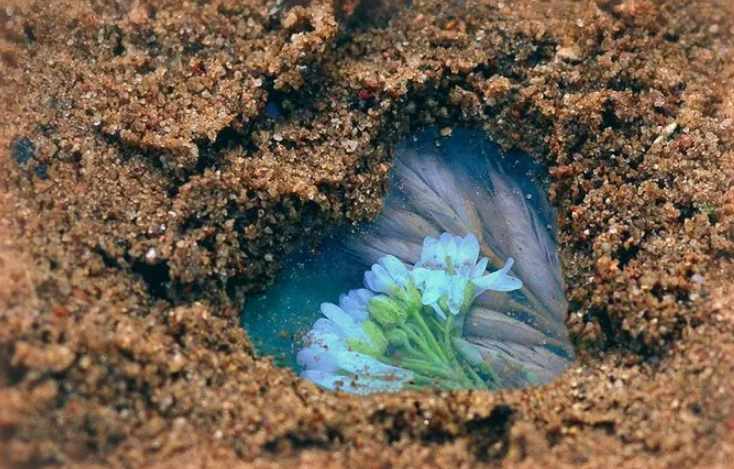
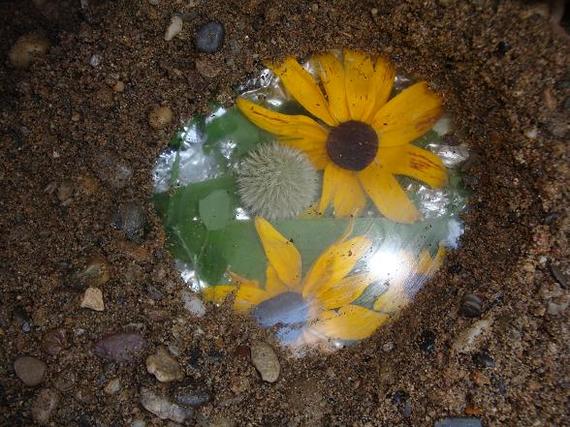
Like many other young girls across the Soviet Union, she will make a small collage. A secluded patch of sand or soil is found, and a small hole dug to hold what former makers called “something beautiful”: flowers, leaves or candy wrappers. Once complete, the collage is covered with glass and covered with soil. Making “sekrets” was primarily a girls’ pastime, centred on creating beautiful compositions from found objects. Boys also took part, though many stories end with them destroying the creations.
Similar games have been documented in Tsarist Russia since the early twentieth century. The practice became particularly popular in the 1970s across the Soviet republics. Its popularity may partly be explained by the limited availability of attractive objects for children: “sekrets” allowed them to create something beautiful and personal from ordinary materials.
The game was especially common in cities, where expanding apartment blocks created communal courtyards and discarded glass was readily available. In Lithuania, the game was called “sekretas” or “paslaptis” (“secret”); in Poland, it was also known as “widoczek” (“little picture”) or “niebko” (“little sky”).
“Sekrets” have also been compared to children’s burial games, in which dead insects or small animals were buried in decorated graves. A similar pattern of concealment and return appears in the Russian tradition of the “burial of the cuckoo”, in which girls buried or concealed a symbolic cuckoo bird and later returned to it.
“Sekrets” can be considered alongside David Sobel’s concept of children’s special places. Like forts and hiding places, they existed largely outside the adult world and were often made from discarded or ordinary materials. Both transformed overlooked spaces and objects into something meaningful to children, allowing them to create a small world of their own.
In post-Soviet countries, the game was still played until around 2000. Today, however, most children no longer know how to make a “sekret”. The environment in which children play has changed: discarded glass is less common, children are more closely supervised, and creative materials and opportunities are more abundant. Perhaps, then, the “something beautiful” that children once carefully hid beneath a piece of glass has simply become too abundant to fit there anymore.
Emilija Jacevičienė (she/her) is a PhD student in Ethnology at Vytautas Magnus University, Lithuania. Her research focuses on children’s street and courtyard games, an understudied area in Lithuanian ethnology. Drawing on historical sources and contemporary ethnographic data, she explores the continuity and transformation of children’s play across rural and urban settings. More broadly, her work examines children’s folklore, material culture, and the ways children create their own spaces and meanings within changing social and historical contexts.