When archaeologist Maria Sommer and Dion Sommer, Professor Emeritus of Developmental Psychology, set out to study early childhood in ancient Attica, they chose to focus on children between birth and the age of seven. This age range, according to them, makes up some of the most invisible people in the whole discipline of archaeology.1 Infants and toddlers leave almost no voice of their own in the historical record. What survives instead are the objects adults made for them, the images adults chose to carve, and the handful of scenes adults thought worth preserving in verse and on stage. Reading those traces is one thing. Working out what they leave out is another, and often the more interesting question.
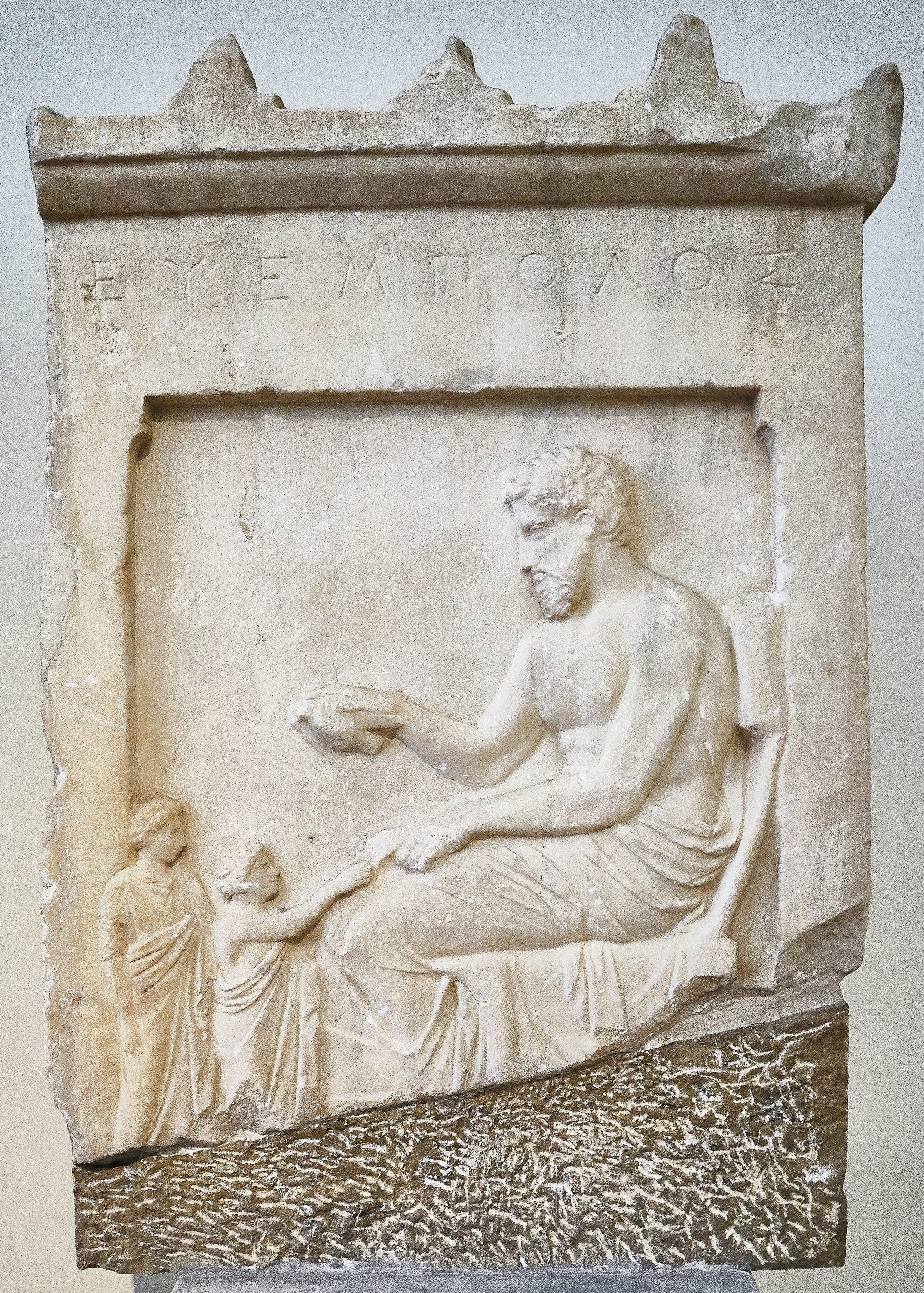
Take a grave stele found in Piraeus, showing a father named Euempolos with his two children. His son stands in front, closest to his father. His daughter stands behind.2 It is one of relatively few surviving monuments that show a father with young children at all, and even here, the composition already tells us something about rank and attention within the family. Fathers on these stelai almost never smile. When they appear with a child, it is far more often an older son than a small one, and the scene is usually the formal farewell handshake marking a boy’s passage out of childhood into the adult world of the household.3 The very young son, the boy still small enough to be carried or held, is strikingly hard to find.
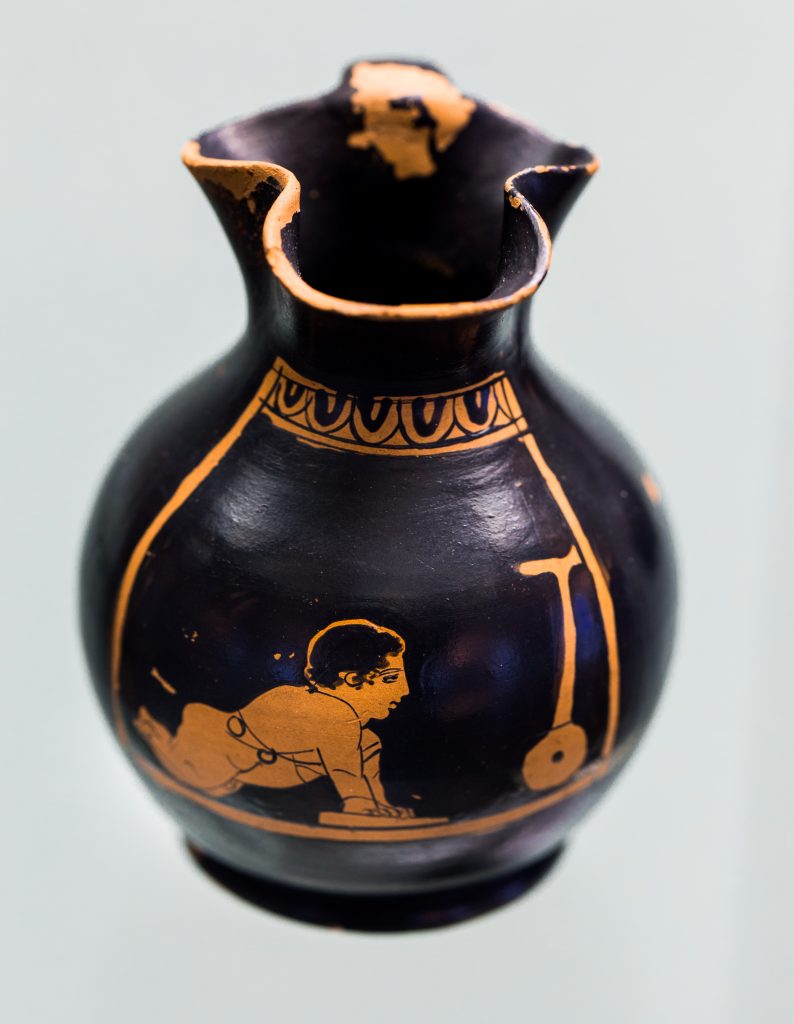
That absence does not mean the same thing everywhere. On other kinds of objects, particularly the small wine jugs called choes given to three-year-old boys during the Anthesteria festival, toddlers appear constantly, crawling, reaching, exploring a room on their own terms.4 The young child was not invisible to Athenian art in general. He was invisible specifically in the company of his father, and specifically on the monuments meant to represent a family’s public face for generations to come. That is a narrower and stranger gap than it first appears, and it is worth sitting with rather than explaining away too quickly.
This is where Sommer and Sommer’s work, documented in their book Care, Socialization and Play in Ancient Attica (2015), becomes useful for more than just cataloguing objects. Their method, which they call developmental childhood archaeology, reads grave stelai, vases, dolls and potsherds through the lens of modern developmental psychology, while still taking the written sources seriously as evidence of how people at the time actually thought about childhood. The result helps reconstruct a world in which these largely unseen children nevertheless lived, played, and grew, even when the surviving pictures show us almost nothing of that process directly.
Credit: Wikimedia Commons.
To understand why the young son is so hard to see beside his father, it helps to look at the position he actually occupied within the household. Aristotle’s Politics distinguishes between the ways a man ruled different members of his oikos, or household. Over his wife, he ruled as one citizen rules another, an equal among equals even though power was unevenly shared. Over his children, he ruled “royally,” because love and the difference in age gave him a natural authority resembling that of a king over his people.5 Aristotle actually names a third form too, easy to overlook. A master’s rule over a slave rested on pure utility. A citizen’s rule over fellow citizens had power rotating between them. A father’s rule over his son rested on something else again, on experience, age, and love.
The word choice matters. Aristotle reserves “despotic” for the master and slave, and reaches for something gentler for the father and son. He is saying, in effect, that a son’s position in the household was legally dependent but not equivalent to property. That still left him without much say in how, or whether, he was shown in public. A father’s public image as kyrios, the household’s formal head, may simply have had no place in it for a small, unfinished, still forming child. The son had to wait, quite literally, to be seen.
The literary record tells a different story than the stelai, and it is worth pausing on exactly how different. There is a scene from Aristophanes in which a new father is so overcome with joy at his child that he becomes comically easy to deceive, and another in which a father takes his infant son from the wet nurse, feeds him from his own mouth and kisses him, calling him his little rascal. Theophrastus, Aristotle’s student and successor as head of the Lyceum, viewed such overflowing paternal feeling with real suspicion, which tells us something useful in itself, as Sommer and Sommer themselves note. A norm only becomes worth criticizing once someone has actually broken it. If doting fathers of small children had not existed, there would have been no reason to warn against them.6 Fragments from Euripides’ lost play Antiope suggest that a mild, loving father was already a culturally recognizable and desirable figure on the Athenian stage, not some later invention.
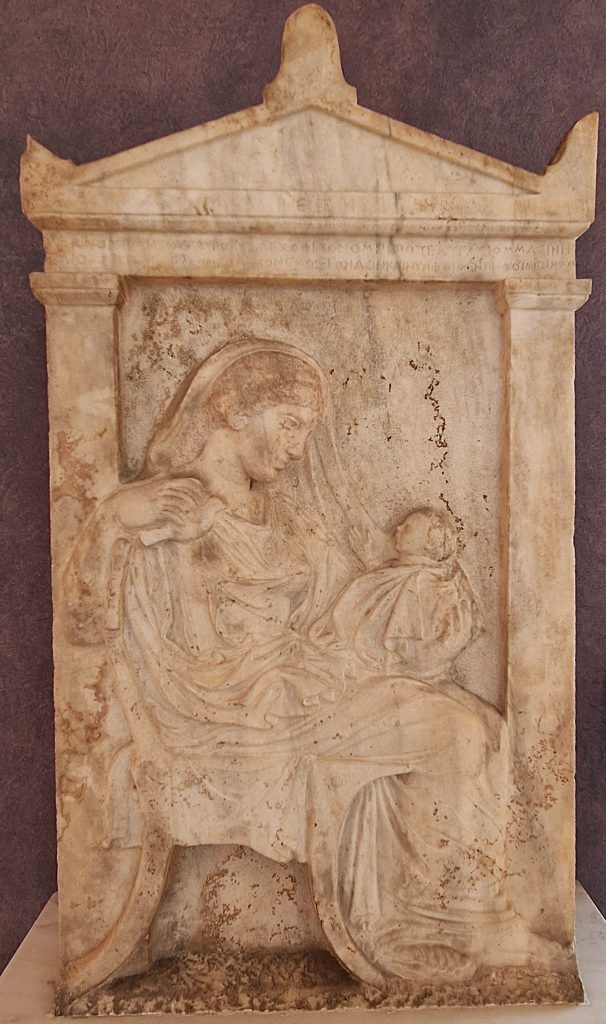
The pattern holds beyond fathers, too. Euripides has the grandson Orestes recall, with evident warmth, that his grandfather raised him as a small boy and often kissed him while carrying him in his arms.7 Grandfathers are, if anything, even harder to find in the material record than fathers, yet here one is remembered with real tenderness. A different kind of source, the Ampharete grave stele, shows a grandmother holding her small dead grandchild, with an inscription recalling how she had once held the same child on her lap while they were both alive and looking at the sun.8 None of these figures, father, grandfather or grandmother, chose to be carved smiling with a small child on a public monument. All the same, we happen to have their words, or something close to them, saying that the affection was there.
Aristotle’s Nicomachean Ethics gives us something closer to a theory of what a small child actually needed, whether or not any particular household lived up to it. His ethics rests on the idea that virtue is not innate but acquired through habit, the same way a musician becomes skilled by playing and a carpenter by building. On this view, a boy could not learn courage or moderation by watching a distant authority figure from across the room. It required repeated practice, correction and praise, which in turn required an adult present enough in his daily life to provide them.
This does not tell us that Athenian fathers were in fact present in this way. It tells us what Aristotle believed a child required in order to become the kind of adult his society valued, and it puts the boy, not the father, at the center of the process. The Ethics’ long discussion of friendship goes further still, describing the parent-child bond as a form of philia, a word covering both friendship and a broader sense of attachment. Parents love their children, Aristotle writes, because they see them as an extension of themselves, almost as a hand or a foot remains part of the body even once separated from it.9 He adds that this friendship is asymmetrical, since a father gives more than a son could ever repay, having given him existence itself. Rather than making the relationship colder, this impossibility of repayment is exactly what Aristotle thinks forces it to run on affection rather than accounting. A son, in this picture, is not simply property waiting to inherit a name. He is someone being shaped, slowly and deliberately, toward a specific kind of adult manhood.
Credit: Wikimedia Commons.
That helps explain why the handshake scenes on the stelai involve older sons rather than small children. The gesture marks a boy’s arrival at the edge of citizenship, not his childhood itself. Athenian visual culture, at least in its most formal, most public form, seems to have been far more interested in the moment a boy became recognizable as a future man than in the years he spent simply being a child. Early childhood belonged to the household, to the mother, the nurse, the grandmother, and the choes cup resting in his own small hands. Public commemoration belonged to the boy who was almost, but not quite, a citizen.
There is a real tension sitting inside that pattern. The very man responsible for shaping a boy’s character, according to Aristotle’s own theory, needed sustained closeness with him during exactly the years the culture was least willing to show. A father could not be seen too often with his smallest children without risking his own reputation for manliness, at the very stage when, by Aristotle’s account, that closeness mattered most. The invisible son, then, is not simply a gap in the evidence. He may be the product of a real and specific cultural pressure, one that separated the private work of raising a boy from the public image a father was allowed to project.
There is a small, almost ironic detail worth ending on. Aristotle’s great work on virtue, character and the good life carries the name Nicomachus, a name that belonged to both his father and his son. According to a later and uncertain tradition, it was the son who edited and published his father’s lecture notes after his death, and it was through this act that the work acquired its title.10 We should not lean too heavily on a tradition no one can fully verify. But after spending this much time looking for the sons who barely appear in the surviving images of Athenian family life, the name takes on a curious resonance anyway. The young sons of classical Athens are hard to find carved beside their fathers on stone. One of them, at least, may have quietly carried his father’s most influential book into the future instead.
An absence in the pictures, in the end, is not automatically an absence in life. It may simply be an absence in what a status conscious society considered fit to display, and in the case of the youngest sons of Athens, that absence appears to have had less to do with whether they were loved than with what, and whom, a family was willing to show the world.
Kasper Brock-Jørgensen (he/him) is a Danish historian specializing in the history of early childhood. He holds an MA (cand.mag.) degree from the University of Copenhagen and works as an independent researcher focused on childhood, pedagogy, and family history. His work appears in both academic and general interest publications.
- Maria Sommer and Dion Sommer, Care, Socialization and Play in Ancient Attica. A Developmental Childhood Archaeological Approach (Aarhus: Aarhus University Press, 2015). ↩︎
- Sommer and Sommer, Care, Socialization and Play in Ancient Attica, p. 48, on the Piraeus grave stele of Euempolos and his two children. ↩︎
- Sommer and Sommer, Care, Socialization and Play in Ancient Attica, p. 48, on the farewell handshake motif and its association with older male children. ↩︎
- Sommer and Sommer, Care, Socialization and Play in Ancient Attica, pp. 71 to 72, on toddlers depicted on choes and other vessels associated with the Anthesteria festival. ↩︎
- Aristotle, Politics, Book I, ch. 12, 1259a37 to 1259b4. ↩︎
- Sommer and Sommer, Care, Socialization and Play in Ancient Attica, pp. 49 to 50, discussing the Aristophanes and Euripides fragments on paternal affection. ↩︎
- Sommer and Sommer, Care, Socialization and Play in Ancient Attica, p. 48, citing Euripides on Orestes and his grandfather. ↩︎
- Sommer and Sommer, Care, Socialization and Play in Ancient Attica, p. 47, on the Ampharete stele, ca. 430 to 420 BC. ↩︎
- Aristotle, Nicomachean Ethics, Book VIII, ch. 12, c. 1161b. ↩︎
- On the title tradition, see Diogenes Laertius, Lives of the Eminent Philosophers, and the Byzantine Suda. ↩︎