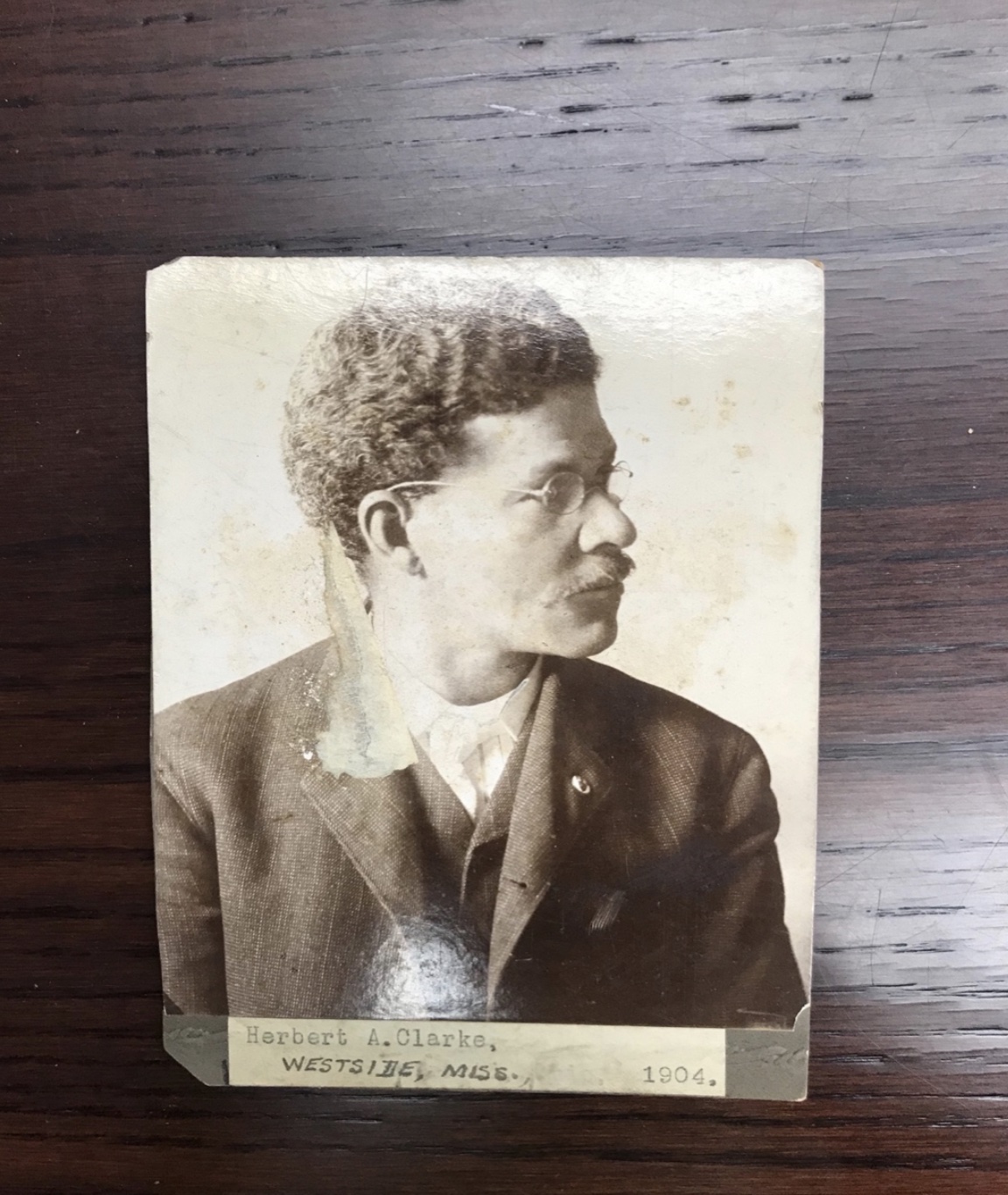
While studying early twentieth-century amateur journalism, Elissa Myers came across articles penned by Ernestine Clark Nesbitt and Consuelo Clark Stewart. Although Myers was already familiar with the works of Ernestine and Consuelo’s brother (Herbert Clark, a prolific Black writer), she had never heard of the two sisters or their writings. What she eventually discovered was a microcosmic oeuvre of short stories, literary criticism, and more all influenced by the intellectual Black girlhoods of Ernestine (a renowned musician, composer, and fashion editor) and Consuelo (one of the first Black women to earn an M.D. from Boston University) in turn-of-the-century Cincinnati.
Myers complied her research into her latest article for 19.3 (October 2026) of the Journal for the History of Childhood and Youth, entitled “Le Bijou: A Hidden Gem of African American Girls’ Amateur Journalism”. Below, she speaks more on her approach to literary studies, Black girlhood, and her ultimate takeaways from the lives and works of Ernestine and Consuelo.
Your article builds such a rich world that I was surprised to learn that there was so little literature and research on Ernestine and Consuelo prior to your article! How did you come across their writings, and what were your first impressions?
I had already read Le Bijou because it is well-known in the amateur journalism world, due to Herbert Clark’s (the Clark sisters’ brother’s) status as the first African American officer of the NAPA. Several other people who study amateur journalism discuss his paper (in particular, Paula Petrik). At that point, I had already been to the American Antiquarian Society to study girls’ amateur journalism, so I was interested in finding more girls’ contributions and papers. I found Herbert Clark’s article “A Drop of Black Ink” in the magazine Ink Drops when I was doing archival research at the Library of Amateur Journalism. In this magazine, he writes of his sisters’ contributions to his papers. In library catalogues where amateur journals are held, there doesn’t tend to be a lot of information about contributors, as there are often lots of contributors to each publication, and their contributions are sometimes short-lived or few. So if a girl edited a magazine, that is usually easier to discover. However, girl contributors are harder to find. As Consuelo and Ernestine only wrote under their first names, it never occurred to me that they might be Clark’s sisters until I discovered Clark’s mention of them in his article. Moreover, because amateur journalism has been discussed as (and seems to have been) a very white and racist community (Herbert Clark himself struggled for recognition), I would not have assumed there were many Black girls who were amateur journalists, if any, before discovering this article.
Amateur journalism might be a new concept to some readers. How would you distinguish it from other forms of youth-created narratives, such as diaries, scrapbooks, zines, etc?
Amateur journals are the historical ancestors of zines in that they are homemade magazines, but with an often quite formulaic structure that included an editorial column where the editor of a paper would discuss other amateur journals and often, share their perspectives on other members of the organization in a gossipy way. They also featured a variety of pieces—including humorous short fiction, poetry, and puzzles. Additionally, they were made on relatively inexpensive tabletop presses. Though many middle class young people could afford one, it is still important to note that not everyone could have; poor children certainly could not have.
In your analysis of the Clark sisters’ writings, one of your questions is “what does it mean to center Black children–not just Black characters or authors. . . in children’s literature studies?” What are the benefits and limitations to discussing Black youth in the context of literature and literary studies?
That is Brigitte Fielder’s question, but I do love it! As far as limitations, it can sometimes be difficult to find historical sources about Black children. However, I think the work of Brigitte Fielder, Nazera Sadiq Wright, Camille Owens, LaKisha Simmons, and many others shows that it is very possible. Additionally, several of these authors use archives prominently in their work, showing that even archival sources are there, if one is determined. Wright’s work, for instance, analyzes scrapbooks. I think the benefits are immense! As Fielder points out, Black children are not often centered—even in children’s literature studies. I think the more work that is done toward centering Black children, the more the field as a whole will come to understand that we must take intersectionality into account when formulating overall theories of children’s literature or “the child,” or perhaps even take caution against forming such theories at all.
I am definitely not the first person to consider that children’s literature should center children of color in its ideas about children as a whole. Marilisa Jimenez-Garcia and Katharine Capshaw have argued that children’s literature should engage more rigorously with other disciplines (such as ethnic studies) and that the insights we gain from centering Latinx and Black children (respectively, in their work) could have field-transforming consequences. I also think centering Black children in nineteenth century sources could help us unsettle any lingering ideas that Black children in the nineteenth century were a monolith. In particular, the work of Consuelo and Ernestine show that even a few generations after slavery, there were Black children who were being prepared to succeed in a middle-class sense—reading extensively, receiving first-rate secondary educations, attending university, and producing creative work. Finally, I think we as a field need to remember that questions about “agency” always need to consider the question, “agency in relation to whom”? Studying Consuelo and Ernestine’s work shows that it is not just adults that children struggled to have agency in relation to (i.e. an idea of children rebelling against their parents or teachers), but also other children who were part of an oppressive majority (i.e. white children). This seems a shift in perspective that we could gain as a field from centering the work of Black children.
You define youthfulness in amateur journalism as the overall “perception of one’s place on a trajectory toward professionalism”. Indeed, we see Ernestine and Consuelo’s writings possess an imaginary, but mature, space. How do Ernestine and Consuelo’s writings challenge and add to the ways in which scholars examine youth?
Like many white teens in amateur journalism, Ernestine and Consuelo’s participation in this community did not have precise boundaries that stopped when they reached adulthood. Unlike many white teens however, they had many other opportunities to practice rhetoric in ways specific to the Black community, and had likely learned to deeply value public speaking and reading from a young age. I think continuing to remember that ideas of youth are always gendered and racialized, and historically specific is important. Finally, Consuelo and Ernestine’s work shows how rewarding it can be to look for children’s and teens’ work in archives, and how, even if there is only a small amount of work to be found, it can yield interesting results.
Another point you raise is Crystal Webster’s concept of “the metaphysical dilemma of Black girlhood”. How does narrative creation, in the form of the articles found in Le Bijou and elsewhere, combat this dilemma?
Consuelo and Ernestine combatted this dilemma by insisting on creating narratives in a community that was very white and male. It was important to me to discuss them as Black girls even though they were in their very late teens and early twenties during the publication of Le Bijou, because as Webster says, Black girls do not always get to be seen and talked about as children. As much as their participation in the hobby was professional training, it was also fun (as it was for white teens). As a fun hobby engaged in mainly by young people, amateur journalism was a way of extending one’s childhood and teenage years for all who participated. And yet, amateur journalism was also a deeply racist environment, and Consuelo and Ernestine had to find ways to navigate and combat potential exclusion, such as hiding their identities by not going to conferences and writing without last names. Consuelo and Ernestine also created narratives about history that challenge the construction of history around whiteness, which is the other part of the dilemma that Webster discusses. Both girls’ stories in Le Bijou show how historical subjects navigate racialized perceptions of them and find ways of controlling these perceptions and narratives as authors.
Ernestine and Consuelo come from a long lineage of Black intellectuals and writers. As mentioned at the top of the article, their father Peter was a renowned socialist leader and educator in Cincinnati, and their brother Herbert was a renowned Black journalist. These literary and scholarly pursuits reflect the ways in which ‘the Black community prized literacy as a collective goal–something to be developed in and for the survival and political efficacy of the larger community’. Can you speak more on the ways that generational, familial, and communal expectations shaped the Clarks’ youth?
Ernestine and Consuelo both were highly educated—with Ernestine finishing high school and studying music, and Consuelo studying at the Cincinnati Art Academy and Boston University’s homeopathic medical school. It seems likely that this was their parents’ expectation for them, as their parents were also highly educated, with their mother graduating from Oberlin. As Herbert recounts in his article in Ink Drops, the siblings received many papers and magazines of the day—both for children and adults, and read extensively. Their father was the principal of Gaines High School, where all the siblings attended. Though Herbert never finished high school, he did go on to edit the first Black newspaper in the Oklahoma territory, The Searchlight. He also taught in Mississippi during his time editing Le Bijou. Though not much is known about his time here, it seems likely that he was motivated by an activist desire to help Black children in the South succeed. Peter Clark was instrumental in the Colored Conventions of Cincinnati and helped edit Frederick Douglass’s paper, The North Star, and so one would assume he wanted his children to be activists as well. Additionally, their great-grandmother, Elizabeth, sued the man to whom she had been enslaved for wages she earned from him after manumission, so they had a proud lineage of resistance to live up to. Nikki Taylor’s biography of Peter Clark is the definitive source on the siblings’ father and their family history.
Finally, what do you want scholars and researchers to take away from the lives and works of the Clark sisters?
Consuelo died quite young and faced much discrimination in her life in the medical profession, in addition to having her depression medicalized in ways that created much more suffering for her. However, Ernestine lived a long and, to all appearances, happy life. She continued to teach music until her old age, and lived with her husband and children. She also stayed connected to Consuelo, however. She helped rescue her sister from the mental asylum, and then named one of her daughters after her. Viewed as an individual, Consuelo’s life had ongoing currents of tragedy and oppression, and that should not be minimized. However, Ernestine’s continued thriving and ongoing connection to her sister shows the power of sibling bonds as a force of resistance to oppression—in this context, racist, misogynistic oppression. For children’s literature and history scholars interested in agency, adult-child relationships often take center stage. I would personally like to see more interest in sibling relationships. Moreover, when looking at children’s work in archives, I would like to see more interest in everyday children who though they may be exceptionally talented, did not produce exceptionally well-known work during their lifetimes. Institutions such as The American Antiquarian Society and The University of Wisconsin’s Library of Amateur Journalism are filled with the work of ordinary children, and this work—including amateur journals, diaries, scrapbooks, and other items, also shows the importance of studying the family context and production of items at home as centrally important to understanding children’s agency.
Something else that is important to take away from Consuelo and Ernestine’s lives and work is that their work as children has value on its own merits, aside from the rest of their lives and later work. Especially because of Consuelo’s early death and the racism and oppression she faced, I think it is important to focus at least as much on the enjoyment and intellectual stimulation the two sisters and their brother seem to have experienced in creating Le Bijou together.
To end on a personal note, we’d like to ask you about a few of your favorite things…
Favorite way of managing notes and/or citations?
Zotero!
Best book in the history of childhood and youth you’ve read in the past year?
Probably Writing Themselves into the Movement: Child Authors of the Black Arts Era by Amy Fish. I love that she focuses on the work of ordinary Black children from the 60s and 70s, beautifully contextualizing and closely reading their work. Also, I love that she draws on conversations in Black Studies as well as conversations in children’s literature about youth agency more generally.
Favorite childhood book?
I had many favorites—usually whatever I happened to be reading at the time. But since we’re talking about Black authors, Roll of Thunder, Hear My Cry was one that stayed at the top of the list for a long time.
Elissa Myers (she/they) is a Visiting Assistant Professor at Sam Houston State University. She does research on nineteenth-century amateur journalism and needlework samplers in the context of early nineteenth-century mission schools for Indigenous girls.