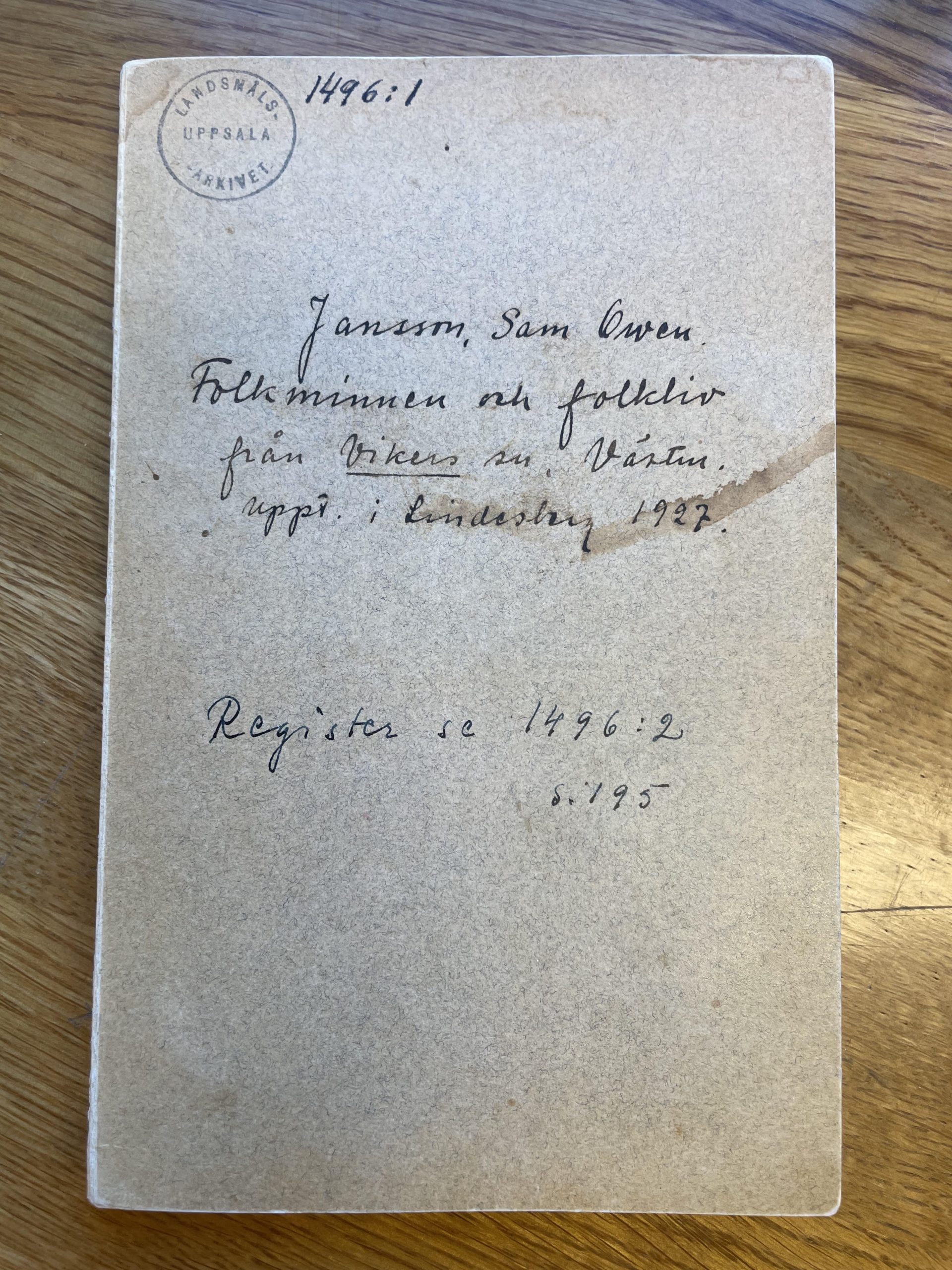
In 1927 a librarian at the Nordic Museum in Stockholm sat down to interview Susanna Jansson, born in 1844. Susanna grew up in Lindesberg, in the centre of the Swedish iron working region. He asked her to tell him everything she could recall from her childhood. He also asked her to describe her first school years, at which she laughed and told the story of how she witnessed firsthand how the school came into existence. At the time, villages like hers did not necessarily have formal schools, but with the 1842 School Act all parishes were required to have at least one. Her father had given permission to use part of the brewhouse, then carried in some wooden planks to be used as furniture. A maid, too weak for harder labour, was appointed teacher. That was it – now the village had a school.
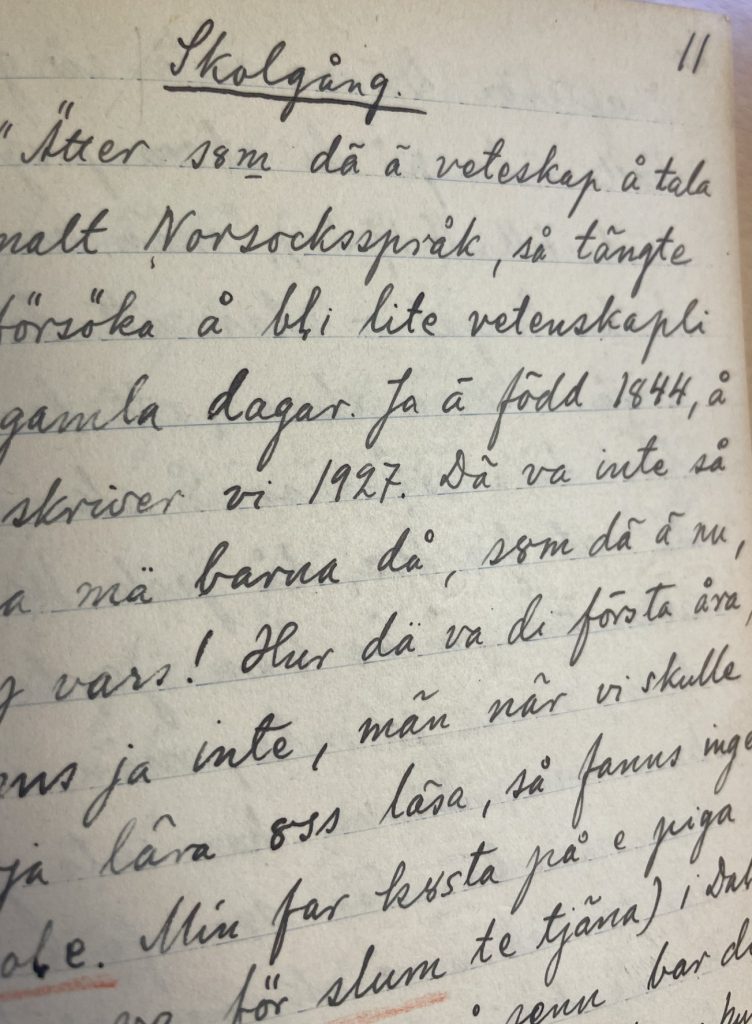
Susanna’s testimony is the oldest source in my dissertation on working class girls’ education between 1840-1920 in Sweden. While it is not her own handwriting, the perspective of the schoolgirl on the birth of the folkskola (elementary school), is unique. The Swedish folkskola was built through local initiative and adaptation. Susanna’s story captures this process from a child’s perspective, showing how educational ambitions and opportunities could emerge in places where no formal school previously existed. In a historical field traditionally resting on Parliamentary material, curricula, inspectors’ reports and the testimony of adult men, this voice reminds us of the actual children playing, reading and walking to school together.
One reason behind the 1927 interview were the efforts of the Nordic Museum to collect everyday objects, music, folk dress and stories about the lives of “ordinary” people at the time. Despite this, it is quite rare for historians to get the first-person perspective of a young rural girl. Most likely the interview took place because Susanna was the grandmother of librarian Sam Owen Jansson. His family’s journey had taken them from the periphery and into the capital, from a basic education to university studies in less than three generations. Thanks to this it is possible to catch a glimpse of Susanna’s first day of school, almost two centuries later.
Susanna’s retelling of her childhood can be found at Institutet för språk och folkminnen (The Institute for Language and Folklore), in Uppsala, ULMA, ”1496: 1 & 2”
Agnes Hamberger (she/her) is a lecturer in history at Dalarna University, Sweden. Her dissertation Flickornas folkskola Genus och utbildning ca. 1840–1920, 2026 (The Girls’ Folkskola: Gender and Education in the Swedish Elementary School ca. 1840–1920) can be accessed open source at https://www.diva-portal.org/smash/record.jsf?pid=diva2%3A2040685&dswid=-7182