The figure of Marjoe Gortner represents one of the most complex and paradoxical cases in the history of American religious childhood. His performative strategies highlight the tight relationship between show business and religion, which turns his public persona—difficult to separate from his agency—into a „childish thing.”
Born in 1944 and baptized with a name that blended Mary and Joseph, Marjoe was dedicated from birth to a career as an evangelist by his preacher parents. His upbringing was a rigid programming of his preaching abilities.
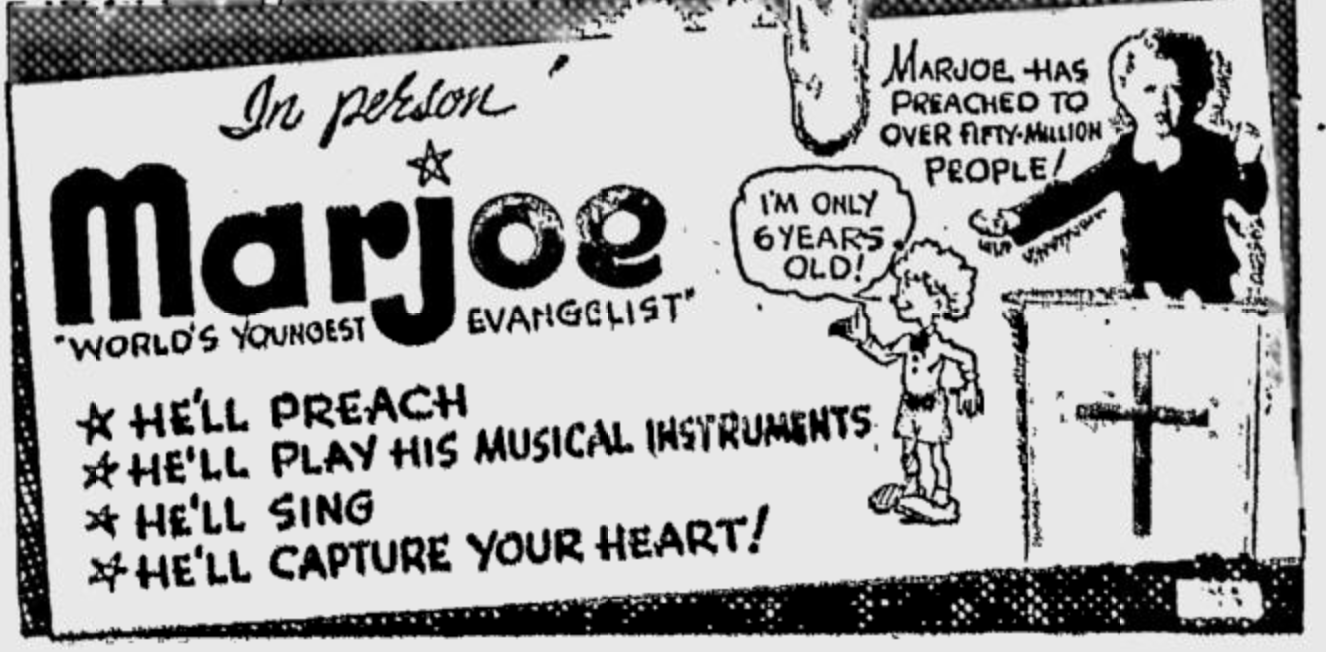
At age four, Marjoe was already a renowned preacher, earning him the titles “preaching machine” and “miracle child”. His performances attracted massive crowds. This was the result of grueling repetition sessions used to memorize sermons and the coded verbal signs used by his mother to manage the stage, so that even a simple “Hallelujah” could function as a command to collect money. The featured advertisement in the Tuscaloosa News from March 16, 1951, further illustrates this.
Marjoe strategically adopted a rock star aesthetic, wearing leather pants, a flashy shirt, and turquoise jewelry. This served several purposes; since his audience equated material success with divine favor, he had to “look good, feel good, and smell good.” Marjoe made a clear distinction between salvation and entertainment, describing his services as “entertainment packaged as salvation.” He used theatrical techniques to induce states of ecstasy: hip movements, jumping on seats, and a rhythmic tone of voice that led followers to believe the Holy Spirit was working through him. His album Bad But Not Evil (1972) reflects his split identity, in which the energy of rock and the rhythms of the pulpit are blended.
In the Oscar-winning documentary Marjoe (1972) and on his farewell tour, Marjoe—now almost in his 30s —revealed the “tricks of the trade,” such as using fake stories and selling allegedly holy items. Nonetheless, it is difficult to say with certainty how much agency he held as a childish thing within that system and how much his own faith extended.
The figure of Marjoe Gortner remains an ambivalent figure in the history of religious childhood. His life leads us to ponder topics such as belief, authenticity, and performance in modern religious contexts. Ultimately, Marjoe Gortner is a product of a system in which it is hard to draw boundaries between manipulation, performance, and personal agency. Image caption: Marjoe Gortner during one of his public performances, in which religious preaching takes on a theatrical dimension.
Nicole Cordioli (she/her) is currently pursuing her Bachelor’s degree in Religious Studies and Philosophy at Heidelberg University. Her focus is on the United States. She is interested in deepening the connection between religion and politics.