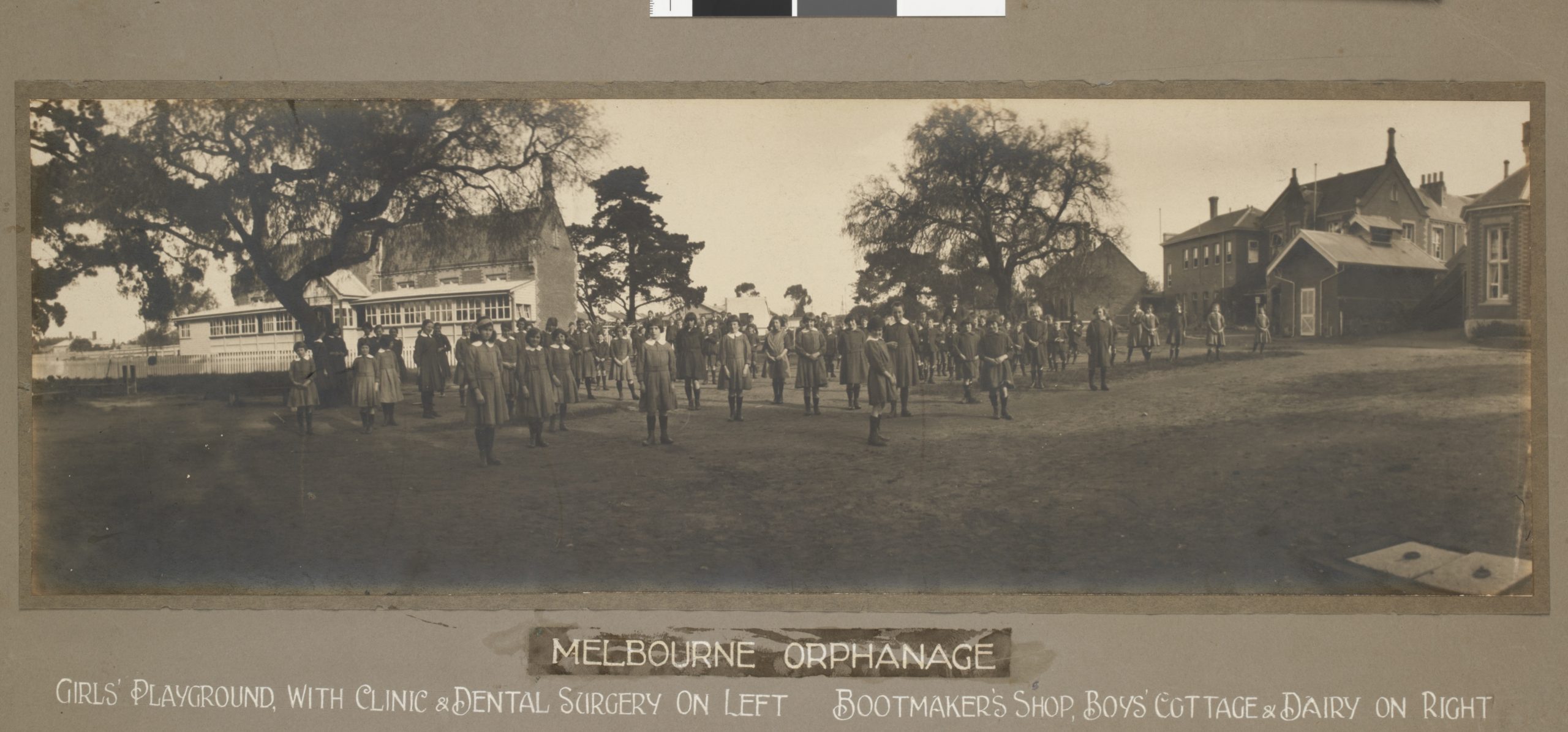
How do we know what we know about institutions for children? While institutional and administrative records may be the easiest path, they rarely tell the full story of children’s experiences. In her wonderful new article ““Orphanage kids ruled”: Methodological Approaches for Histories of Education at the Melbourne Orphanage, 1900-1965” in the Journal for the History of Childhood and Youth, Beth Marsden dives deeply into a variety of records about the Melbourne Orphanage to re-center marginalized children’s voices. Here, she shares some of her insights.
What a fascinating article! What is one thing you want readers to take away from it?
My main motivation with this paper was to challenge the idea that historians need access to personal records to write about children’s experiences. Sometimes, particularly with marginalized children, records were never created or may no longer exist. There are also ethical reasons for not always or only relying on official records about marginalized children. I hope this piece encourages historians to write histories of children that were left out of, or misrepresented in, ‘official’ documents.
You weave together the institutional histories of the Melbourne Orphanage and accounts by former residents. How do these voices change the narrative?
These voices are the narrative! I’m fascinated by the differences in how children experience their lives and the ways that adults and adult-created sources portray children’s worlds. Including the accounts of the former residents creates the space for a more rounded, critical and nuanced narrative of education at the Melbourne Orphanage to emerge. I hope it also gives shape to the types of educational opportunities that were available to children who grew up in ‘care’, in other institutions.
You point out that the voices of former residents are not authored by children but by adults, decades after their stay in the orphanage. How does this temporal element limit these sources and how much they can reveal about the “now” or “being” of the child?
It’s an interesting question. All sources are fallible, of course, including those created by people in positions of power and authority, whether Melbourne Orphanage Committee members or Education Department officials. Much has been written about memory and oral histories and their veracity as historical sources, but when these are the only source created by those who experienced the institution, then I think we have a responsibility to centre them. They might be limited, but they also provide opportunities for locating points of tension or disjuncture with other sources. That, I think, is a productive place to write from.
Within orphanages, children were often framed as mere “objects of charity.” How does their participation in labor as well as their own wishes about their education complicate this framing?
The work demands placed upon children and the denial of their education is paradoxical at the least: It’s not charity. It’s a transaction based on children’s labour, a kind of contract that children are subject to without agreement. I’m fascinated by how ‘charity’ is performed and rationalised by the powerful. In 1947 Scottish philanthropist, Lady Edith Dixon, visited the children at the Melbourne Orphanage, and newspaper reports quoted her telling the children that they were “lucky” and among the “best- off kiddies in the world.” If Dixon’s comments are considered together with the limited education available to the children, the incongruities of ‘charity’ become apparent.
What is one memory or account by a former resident you remember as particularly striking?
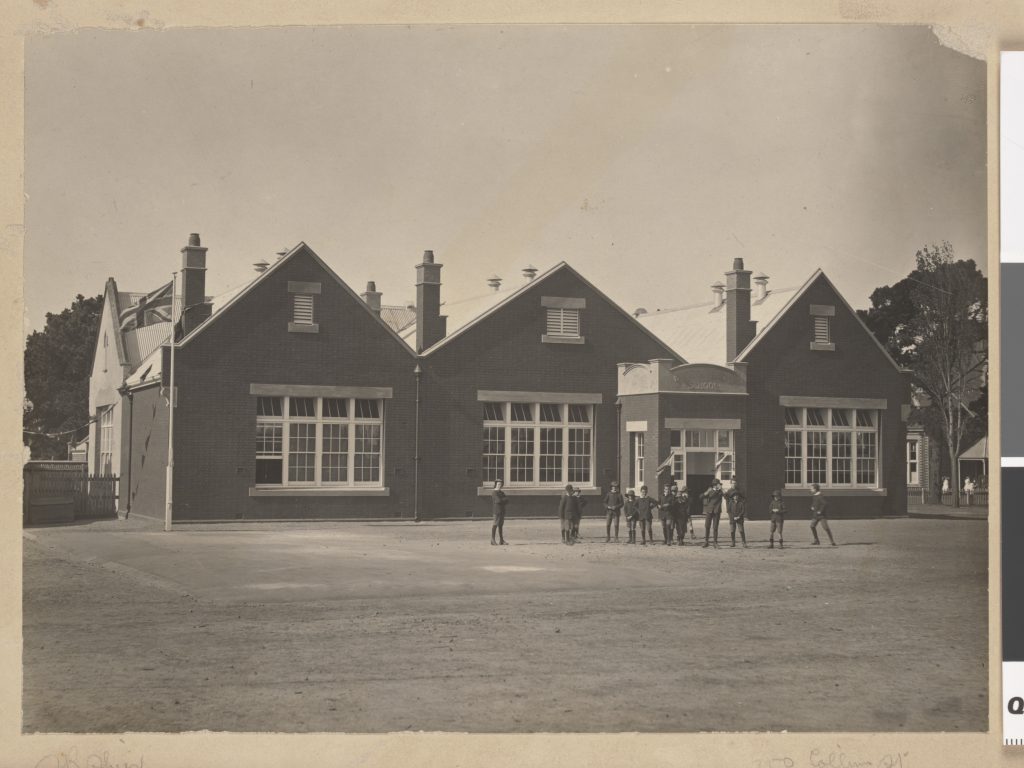
Russell Saffron’s recollection that ‘Orphanage kids ruled’ at the Brighton Beach State School really jumped out at me when I first listened to his interview. In Australian ‘care’ leavers testimonies, many remember attending school with children from the local neighbourhood as stigmatising. Russell’s comment jumped out at me as distinct from those stories. Through it, I became interested in the spatial arrangements of the State school, situated on the grounds of the Orphanage, as an unusual site and dynamics for investigating educational opportunities.
Your article importantly calls out the omission of Indigenous children’s presence at the Melbourne Orphanage. How did you first stumble upon these children?
Initially, it was confusion that led me to the Melbourne Orphanage. I’d found several letters
about two very young First Nations children who had been forcibly removed from their families in the Northern Territory and sent to an institution in Brighton in the early 1930s. I was sure this was the Melbourne Orphanage, but later realised it was a Babies Home a few streets away-thank goodness for Find and Connect! Once I made this connection, I remembered reading Aunty Audrey’s story in Aboriginal Elders Voices: Stories of the ‘Tide of History’ about living at the Orphanage. Combined with Nell Musgrove’s references to First Nations children being at the Orphanage in the 1800s in The Scars Remain, it became clear that First Nations children had been sent there until at least the 1950s, and there was very little acknowledgement of that. Together with my research on experiences of First Nations children in ‘mainstream’ institutions in Victoria like the Tally Ho Boys’ Training Farm, I’ve come to understand that First Nations children were sent to many institutions designed for settler children, even when there is no immediately obvious evidence to show that.
As part of your broader research, what do you envision as a way forward to re-center First Nation children’s stories in Australian orphanages?
This is a complicated question that I am not sure is for me to answer. Organisations like the Healing Foundation, who work with survivors of the Stolen Generations, have several public education campaigns designed to increase the public awareness about institutionalisation. The work of First Nations historians and archivists is also critical for challenging how we think about archives and history. Nat Harkin’s recent paper, “‘Our descendants need you’: an archival-poetics manifesto for a just making of history”, springs to mind. For non-Indigenous settler historians like me, there is an imperative to keep in mind that, historically, most of the policies targeting First Nations people were predicated on their elimination. This shapes the archives we work with. We must be on guard against the metanarratives of settler Australia and routinely widen our nets to include sources far beyond the reach of the official records.
Can you share what happened to the Melbourne Orphanage?
The Melbourne Orphanage buildings were closed in 1965, and the organisation began operating instead in family group homes, changing its name to the Melbourne Family Care Organisation. The main orphanage buildings at Brighton were demolished, and the large grounds and farm areas were subdivided and sold as house blocks. But the Brighton Beach State School is still there with many of the original buildings still being used by the teachers and students.
To end on a personal note, we’d like to ask you about a few of your favorite things…
a. Favorite way of managing notes and/or citations?
Not so much a favourite way as an entrenched bad habit of keeping slightly chaotic thematic notes across numerous word documents. I’ve failed to master any citation software and justify this inefficiency by telling myself they don’t really work for archival references.
b. Best book in the history of childhood and youth you’ve read in the past year?
I’ve been reading Emily Gallagher’s beautifully written new book, Playtime, this year, and I also keep going back to Jo Faulkner’s Representing Aboriginal Childhood: The Politics of Memory and Forgetting and The Importance of Being Innocent: Why We Worry About Children. Jo is a philosopher rather than a historian but her work illuminates so much about the history of childhood in Australia and the ways it is inextricably linked to settler colonialism.
c. Favorite childhood book?
An old red, hardcover copy of Johanna Spyri’s Heidi that I absolutely adored.
d. Best piece of advice you remember receiving as a child?
Not sure if it’s advice per se but I was encouraged to play outside as much as possible and I appreciate now that this helped me develop a love of nature.
Beth Marsden is a non-Indigenous settler historian, and currently a McKenzie Postdoctoral Research Fellow in the School of Philosophical and Historical Studies at the University of Melbourne. Her research interests include histories of childhood, education and experiences in peripheral spaces. She is writing her first book Skipping School: A History of Truancy (Palgrave McMillan, 2027), and is also working on a national history of First Nations education in Australia.