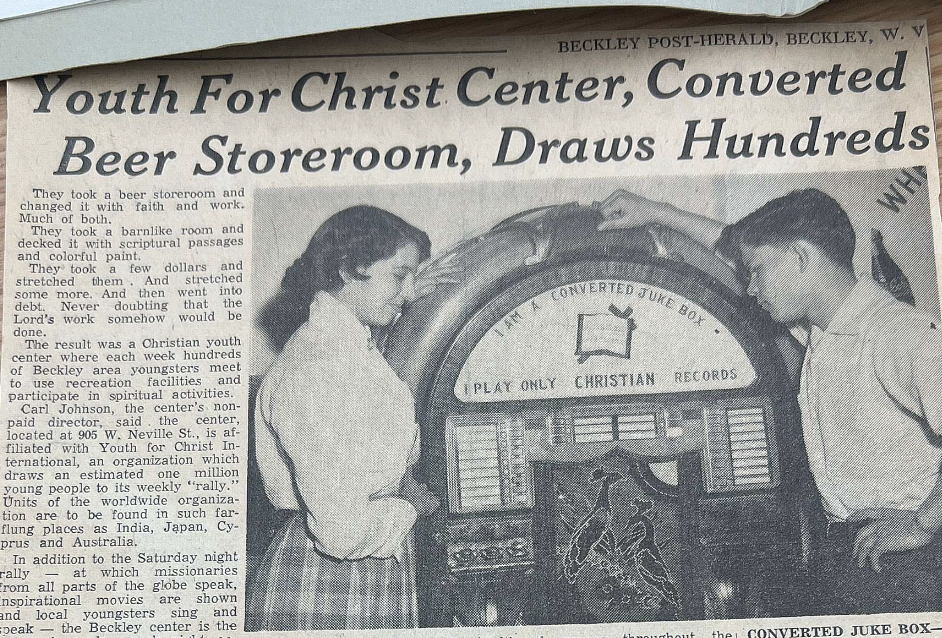
In 1954, a news article from the Beckley News-Herald reported that a Christian youth organization, called Youth for Christ, had converted an old beer storeroom into a youth center in the small West Virginia town. The article featured a photo of two teenagers next to a juke box in the new youth center. The juke box had many of the normal features of the increasingly popular music technology, but there was also something distinct about it. On its face, the Youth for Christ juke box testified to its conversion, stating, “I am a converted juke box. I play only Christian records.”
The converted juke box in the Beckley youth center exemplifies Youth for Christ’s approach to attract teenagers to its ministry. The organization sought to evangelize to teenagers at a time when a distinct youth culture was emerging in American society. This youth culture began to take form primarily through the production of different media such as radio, television, film, and music. Technologies like the juke box became emblematic of such youth culture, and Youth for Christ saw these technologies as an opportunity to appear relevant to the teenagers they hoped to convert.
The challenge for Youth for Christ was to find a way to engage with this media technology in a way that did not sacrifice their sanctity. The organization grew out of the conservative fundamentalist movement of the early 20th century, which often shunned engagement with popular media technology and warned that film and popular music were used by the devil to draw people away from the Church. By converting a juke box, however, Youth for Christ forged a new path of interacting with popular media in hopes that they could sanctify the media technology. They separated the form of the juke box (the machine itself) from its content (the song catalog) with the belief that true conversion and sanctification came from inside oneself. The effect of such a conversion reshaped the boundaries between what conservative Protestants in America saw as sacred and what they saw as secular. In making this conversion, Youth for Christ believed they could use media that had previously been deemed secular to attract teenagers to their ministry without sacrificing their sanctity.
Sam Herrmann (he/him) is a PhD Candidate in Religious Studies at the University of Pennsylvania. He is currently writing a dissertation on the evangelical youth organization Youth for Christ and how it contributed to the development of a distinct evangelical aesthetic style in postwar America. With a broad focus on religion in America in the twentieth century, Sam’s research looks at the roles of media, aesthetics, and the nuclear family in structuring religious identity within American, late-capitalist society.