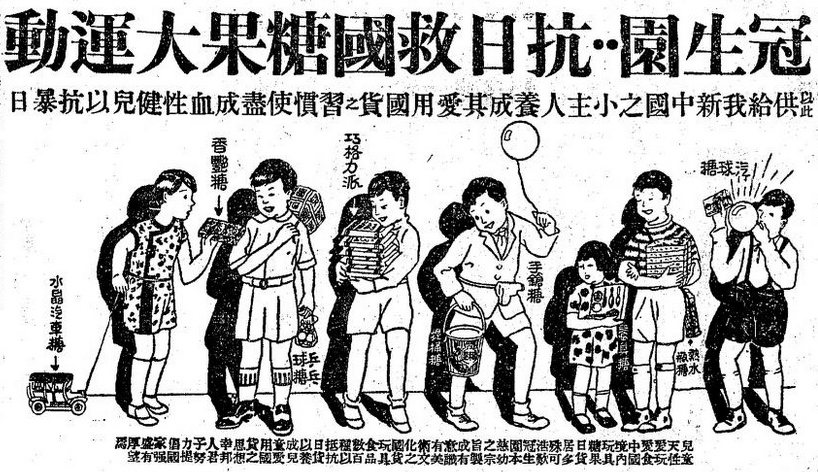
On 2nd October 1931, a couple of weeks after the so-called Mukden Incident staged by the Japanese as an excuse for invading Manchuria, readers of the newspaper Shenbao (Shanghai News) who looked at the adverts learned about a “great campaign” to “resist Japan and save the nation” – by means of candy (fig. 1).
The “campaign” was promoted by food company Guanshengyuan. It framed confectionery as a tool for getting the “new China’s little masters” accustomed to using “national goods”, and resisting the Japanese. Children, who according to the advert “naturally” loved playing and loved eating, ought to consume the company’s “artistic and cultured” sweets, instead of the “lamentably” widespread Japanese goods.
Two days later, another advertisement further harnessed confectionery to patriotic education (fig. 2).
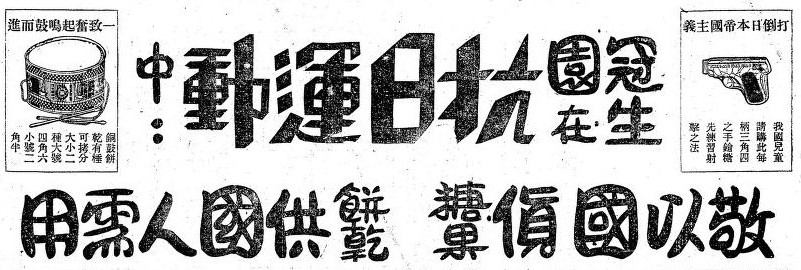
The advert placed the consumption of cookies and candy within the “anti-Japanese movement.” At times, it was quite confrontational. For example, the advert promoted cookie cars as “highly scientific toy foodstuff”, with a “novel”, “smoothly rolling” car-shaped package. By contrast, cookie drums and pistol candy struck a more militaristic note – even while other contemporary Guanshengyuan adverts still construed them as combining education with play and nourishment. The cookie drum set came with sticks to beat it, perhaps for “rising together” and “advancing”, as the claim went. And pistol candy was said to offer children an early training in shooting, possibly to “overthrow Japanese imperialism”, as the slogan declared.
In 1933, Guanshengyuan’s resolve to prepare children for national emergencies extended even further (fig. 3).
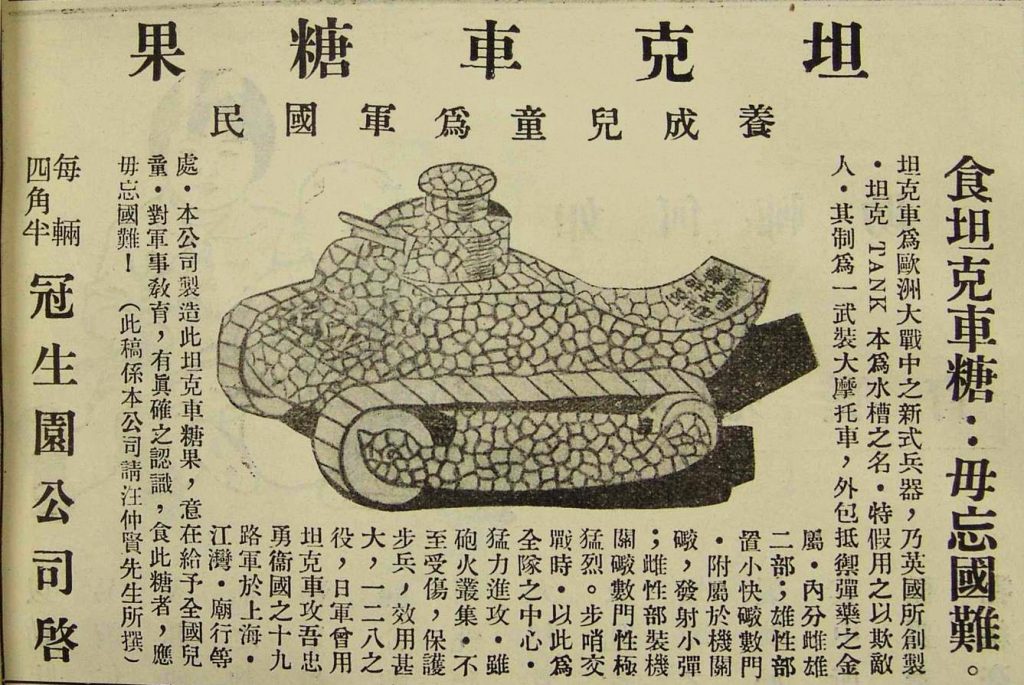
Its advert in the periodical Xiandai fumu (Modern Parents) treated readers to a short lesson on tanks, including their role in the 1932 Japanese attack on Shanghai. It also construed the company’s tank candy as an aid for raising activist citizens, conversant with the military. Eating the candy, moreover, children would “never forget the national crisis” – namely, China’s imperiled state of Japanese encroachment.
Guanshengyuan’s strategy combined then-current appeals for patriotic consumption and national salvation with ideas about childhood and leisure promoted by experts from the early twentieth century. In particular, it built upon conceptions of children as “naturally” play-loving, and of toys as key instructive tools for shaping youngsters into citizens who would rescue China. This marketing approach was far from unusual. At the same time, however, the company piggybacked on expert discourses in order to attach the educational-scientific-artistic tag to items that, to many experts, would have had little educational value – because, like traditional edible toys, these products combined playing and eating, which according to experts ought to be kept separate.
Valentina Boretti is Research Associate in the Department of History at SOAS University of London. She works on the cultural history of modern China. Her current research uses leisure, material culture, and extra-curricular education to explore the making and mobilizing of child and adult citizens from the 1900s to the 1970s. Her most recent publications discuss the gendering of children (in The Routledge Companion to Gender and Childhood, ed. Mary Zaborskis, 2025), and approaches to science and technology through toys (in Rethinking Childhood in Modern Chinese History, ed. Isabella Jackson and Yushu Geng, 2025) in twentieth-century China.