Most of us conceive of childhood and maternity as separate, linearly progressive stages of life. First comes childhood, then comes puberty, then comes adulthood and reproduction. However, scholars continue to uncover global instances that defy this orderly progression. They have also highlighted how race, class, gender, and disability impact how mature a growing person is considered to be.
In the first 2026 issue of the Journal for the History of Childhood and Youth, Bianca Premo grapples with these tensions in her insightful article “The Girl Who Jumped over Childhood: Evolutionary Time and Peru’s Youngest Mother in the World, 1939.” In this interview, she offers some insights into her research.
Dear Bianca, your nuanced article tells part of the story of the “world’s youngest mother,” five-year-old Lina Medina, from Peru, who gave birth in 1939. This is a shocking story. What were some ethical challenges you navigated in your research, including representing Lina Medina’s own voice?
Thank you. This is an important question to begin with since ethics are critical to the larger project this article draws on. If she’s alive today, Lina Medina would be in her 90s and has mostly rejected publicity and advocacy as an adult. But her story and image are everywhere on the Internet and in medical texts, just as they were a huge press sensation at the time she gave birth. So, this is clearly a very sensitive history to write.
I join a long line of observers from 1939 to today, some of whom have grappled with questions of ethics and care. The motivations of these exploiters and advocates—physicians, politicians, journalists, artists and activists—are my principal focus. This article, while less about ethics, still focuses how others have commandeered this troubling story to advance their own projects and principles rather than on how Lina experienced events.
With this article, you focus on one specific newspaper article in La Crónica, published shortly after the news of the birth of Lina’s baby. Explain to us why you chose to focus your article on this source.
A lot of captivating pieces appeared during the period at that time in Lima’s La Crónica, which held an exclusive. But this particular article and its artwork caught my eye. For three months after she was diagnosed, Lina’s Peruvian handlers used La Crónica to whiten or un-race her image, making sure the case was regarded as a scientific breakthrough with universal meaning rather than anthropological spectacle.
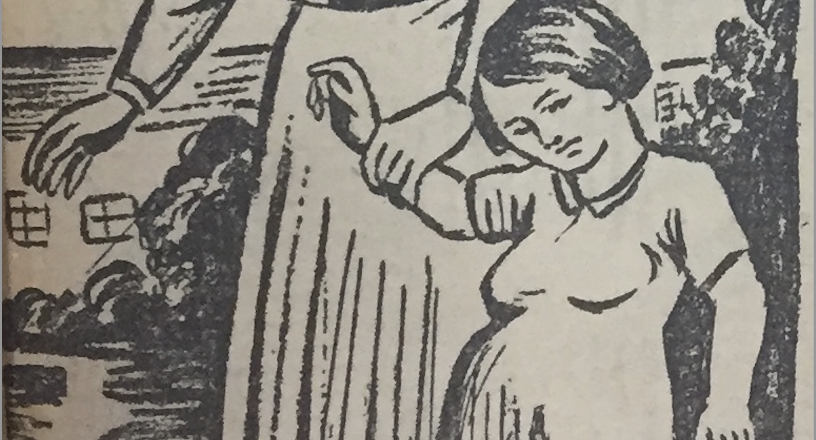
This one article seemed to defy or complicate that campaign. It reprinted an article from a Bogotá paper on Lina and evolution, along with a montage that placed Lina Medina’s photographic image—one of the early exclusives—next to drawn illustrations of other, racially diverse global cases of “precocious maternity” or “extraordinary motherhood.” I was struck by the Peruvian illustrator’s decision to place the single photo of Lina a bit off center in the montage. It represents Lina as stand-out example but not singular; her case is at once “normal” and framed as a scientific, evolutionary breakthrough.
How does your article contribute to ongoing scholarship that grapples with Western ideas of progressive temporality and childhood?
I’d say that scholars of the Global South are working on the puzzle of precisely how ideas of age mapped onto racialized ideas of world region and temporality. How could the common Western belief that non-white girls accelerated into sexual adulthood be a marker of regional or racial backwardness on time scales? For me, the formulation of feminist scholar Carla Rice was helpful: precocious girls are considered “an undesirable mixture of fast and slow.” This phrase unlocked for me how contemporaries understood Lina’s maternity to herald a rapidly evolving “national race” in Peru, even though they still imagined languid Indigenous to be a problem. Prominent Peruvians like Dr. Carlos Enrique Paz Soldán tried to recode the fast-and-slow of precocity into something positive for the nation.
In thinking about Peru as part of the Global South, I’m particularly intrigued by Ishita Pande’s brilliant work on child marriage and “the law’s temporality” in early 20th-century India. She shows how debates around child marriage rested on anxieties about the precocious sexualization of Indian women, which were interpreted as manifesting India’s own asynchronous (under)development as a world region. I hope my article, especially the conclusion, hints at space for more dialogue among scholars of the Global South to discuss regional differences and shared experiences with ideas of biological and world historical time.
Tell us a bit about how medical debates of the time framed the condition of “precocious puberty” in racial and gendered dimensions? How did this tragic case fit into these debates?
Some of your readers might know about the long-held Western belief that women from warm, lowland climates reach puberty, or at least menses, earlier than those from colder climates, making them “jump over” childhood or adolescence. This was a racialized as well as environmental notion, so it was not difficult to apply it to the altitudes of the Andes. That said, the article shows that the idea that hormones could spontaneously trigger early puberty among diverse types of girls was relatively new. So, to an extent, the case stumped scientists. Some foreign physicians like the editor of the JAMA in the U.S. at first rejected the story, and the famous Spanish endocrinologist Gregorio Marañón for years ignored Lina’s case since it disrupted his working theory about sex differentiation.
In my larger project I show that over time Lina’s maternity nonetheless became medically accepted and used to showcase the wide “normal” range of female puberty. One researcher wrote that, if a girl experiencing early puberty could avoid sex, everything biologically would return to “normal.” As one can see, by normalizing Lina as a case study, he and other observers, including La Crónica, avoided addressing the sexual abuse that caused her pregnancy. Lina wouldn’t really be considered a victim, as opposed to a marvel or a case study, until the 21st century.
What does the response to this case reveal about national Peruvian self-understanding in 1939?
At a narrative level, skepticism from foreigners, especially the medical establishment in the U.S., provoked a defense of Peruvian medicine. But at a more analytical level, Latin Americans read into the case theories of time—especially evolutionary time— to claim a central role in a quickly approaching future. They advanced the pro-natalist idea by giving birth so young, Lina was inaugurating a new timeline of evolution, in which all girls of the world—including those from the “West”—might become mothers. That the world’s youngest mother was from Peru was critical, but by placing her among other global cases of extraordinary maternity, she could be a universal portent.
What role do images of childhood and children play in your research, both illustrations and photos? How does your approach to them differ?
My approaches to the two differ, even though I respect arguments that the distinction is artificial. The Peruvian public’s understanding of what was happening to Lina in the months around the birth came mostly from the pen of illustrators for La Crónica, whose representations were often allegorical. I freely reproduce these images. But I find photographs to be a more complex matter. There’s a deeply disturbing one of her pregnant that floats around a lot on the Internet. And, after the birth, papers around the world ran paparazzi shots or posed photos of Lina and the baby, often surrounded by doctors and nurses. Taking some cues from scholars of lynching, colonial photography of children, and more, I think these can be used only if we dedicate space to discussing the violence of their production and ethical viewing. Not every narrative can carry that weight, so I mostly refrain from reproducing them.
Still, in the article, I do reproduce the montage from La Crónica that has a photo of Lina within it. Seeing the full montage reveals the peculiar way the photo fits into the illustration, which parallels the way she fit into claims about “extraordinary motherhood” around the world—unique yet normal. But I obscured her face to acknowledge that the photo was taken without the consent of a small child. An imperfect solution, perhaps, but a solution.
Tell us about your forthcoming book! How does it expand the argument of your article?
As I mentioned, the book will be about the motivations and ethics of possessing, protecting and profiting from Lina Medina and her story from 1939 to today. In it, ethics aren’t just a methodological question. They’re an object of investigation. There is an evolving medical history contained within the study about how the case contributed to the modern diagnosis of “constitutional precocious puberty.” But the book will roam far beyond medical history, covering a pretty wild array of people who intersected to various degrees with her story in the 20th and 21st centuries, including Leon Trotsky, the founder of roller derby, U.S. Immigration and Naturalization Services, Simone de Beauvoir and a Peruvian fashion designer.
To end on a personal note, we’d like to ask you about a few of your favorite things…
a. Favorite way of managing notes and/or citations?
Until now, most of my scholarship is on Latin America’s colonial period, where near everything is manuscript. I think working in the 20th and 21st centuries for the first time, with so many images, blew my mind and, with it, my note taking strategies! My old standby is Endnote but, for this project, all bets were off and I used multiple note methods, including Scrivener and even just Word, depending on the source.
b. Best book in the history of childhood and youth you’ve read in the past year?
Susana Sosenski’s Robachicos, a terrific book on a kidnapping panic in Mexico, recently came out in English as The Fear of Robachicos in Mexico City. It deserves a wide readership, as does Elena Jackson Albarrán’s Good Neighbor Empires, about children and Pan Americanism.
c. Favorite childhood book?
Two Good Friends by Judy Denton. 1974. Difference can be the foundation of love.
d. Best piece of advice you remember receiving as a child?
Upon leaving for middle school, Mr. Charles Stewart, my fifth-grade teacher, wrote in my autograph book “Life is hard for dreamers like you and me, but, in the end, we get by just fine.”
Bianca Premo is Distinguished University Professor of History at Florida International University. Her work on childhood and age in Latin America includes Children of the Father King: Youth, Authority and Legal Minority in Peru, 1650-1820 (UNC, 2005) and various book chapters and articles, including in the American Historical Review and the inaugural issue of the Journal of the History of Childhood and Youth.